Key Takeaways:
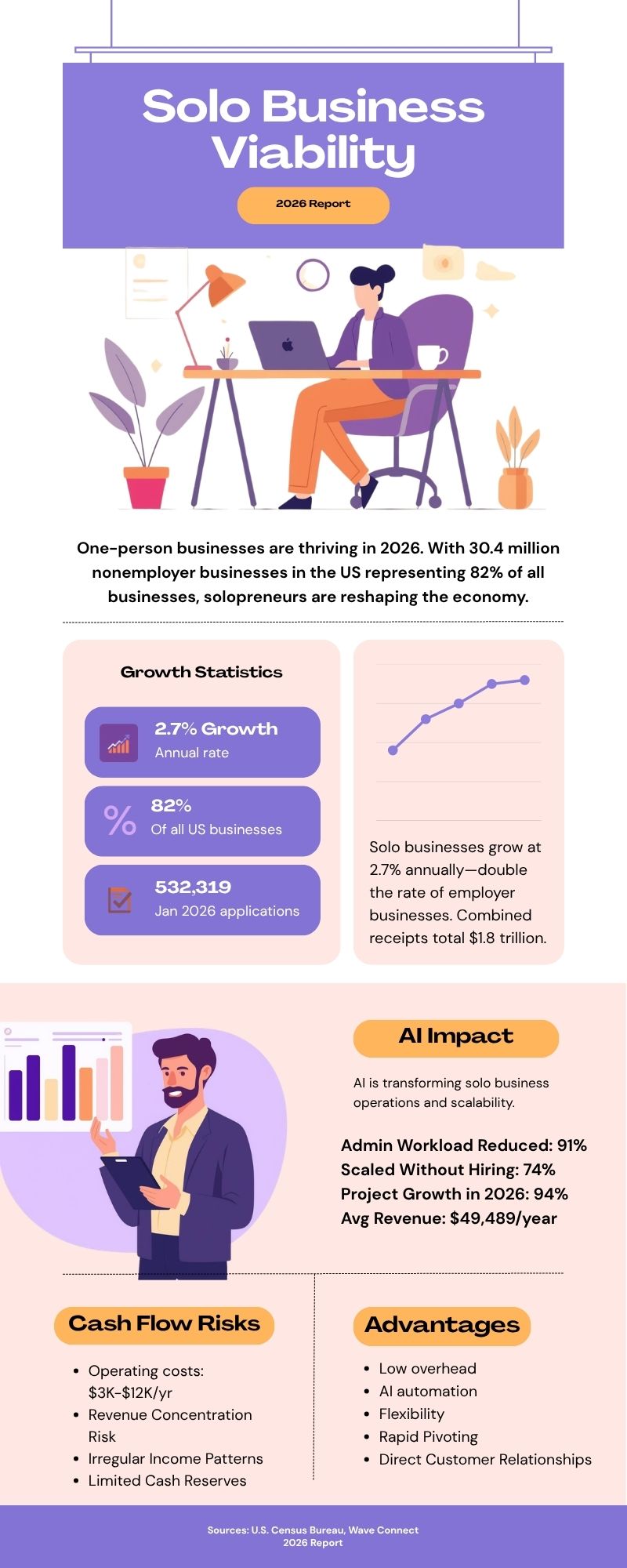
- One-person businesses are growing faster than any other business category. Nonemployer businesses grew at 2.7% annually from 2012–2023 — more than double the rate of employer businesses — and that trajectory has only accelerated since.
- The average revenue figure ($49,489/year) is misleading without context. Operating costs for a solo business run between $3,000–$12,000 annually, compared to $300,000+ for even a minimal team. Profitability, not gross income, is the relevant metric.
- AI has structurally changed what one person can do. 91% of solopreneurs report AI has reduced their admin workload, 74% have scaled without hiring because of it, and high-performing solo operators using AI are growing revenue at 2.3x the rate of those who aren’t.
- Being small is now a genuine competitive advantage — not a liability. Clients increasingly pay a premium for direct access, consistent relationships, and faster turnaround — things that agency structures struggle to deliver by design.
- The biggest killers aren’t competition; they’re cash flow and revenue concentration. Most solo businesses that fail do so because profit and cash flow get conflated, or because the entire business depends on a handful of clients. Structure matters more than hustle.
- Confidence among solo operators is at an all-time high. A record 94% of small business owners project growth in 2026, with an average projected revenue increase of 7.9% — sentiment backed by 535,000 monthly business applications showing no seasonal slowdown.
- Viability is model-dependent, not category-dependent. The data doesn’t say one-person businesses are universally viable — it says they work exceptionally well for operators who build in leverage, specialize deeply, use AI as infrastructure, and prioritize recurring revenue from the start.
The short answer is yes — but the landscape has fundamentally changed. One-person businesses are not just surviving in 2026; they are multiplying at a rate that outpaces every other business category in the United States. The U.S. Census Bureau recorded 30.4 million nonemployer businesses in 2023, generating a combined $1.8 trillion in receipts. That figure has only grown since. In January 2026 alone, 532,319 business applications were filed — seasonally adjusted — making the starting line more crowded than at any point in modern economic history.
But “crowded” does not mean “closed.” What it means is that the rules for building a successful one-person business have changed dramatically. The operators winning in 2026 are not working harder than those who came before them. They are working differently — leaner, faster, and with an AI-powered infrastructure that, five years ago, would have required an entire department to replicate. This article examines the data behind the one-person business boom, the structural advantages solo operators carry into 2026, the real obstacles standing in the way, and the specific strategies that separate the ones who thrive from the ones who stall.
The Numbers Behind the Boom: 30 Million Businesses, One Workforce
The Scale Most People Miss
The scale of solo business ownership in the United States is staggering, and most people — including many of the people running these businesses — have no idea how large the category actually is.
According to Wave Connect’s 2026 Small Business Statistics report, there are currently 36.2 million small businesses in the United States, representing 99.9% of all U.S. businesses. Of those, the overwhelming majority — approximately 82% — operate with no paid employees whatsoever. That means roughly 29.8 million businesses in America are run by a single person. They are not outliers or hobbyists. They are, by volume, the defining shape of American enterprise.
Growth That Outpaces Every Other Business Category
Nonemployer businesses have grown at an average of 2.7% per year from 2012 to 2023, according to Census Bureau data — more than double the 1.1% growth rate of employer businesses over the same period. Post-pandemic growth surged even harder: nonemployer establishments jumped 4.9% in 2021 and 4.7% in 2022. The trajectory is unambiguous. Solo business formation is not a pandemic anomaly. It is a structural economic shift.
Four Forces Driving the Shift
What is driving it? According to PrometAI’s analysis of the solopreneur landscape, four forces have converged simultaneously. The cost curve for running a business has collapsed. Geography no longer limits customer access. The freelance and creator economy has normalized independent income. And, most critically, AI tools have handed one person the operational capacity that previously required a team. These forces are not going away. If anything, they are accelerating.
The Economic Footprint
The Zoom and Upwork Small Business AI Report found that 29.8 million solopreneurs currently contribute roughly $1.7 trillion to the U.S. economy — equal to nearly 7% of total U.S. economic activity. More than 70 million Americans now participate in the independent workforce in some capacity, representing approximately 36% of the total labor force. This is not a side-hustle statistic. This is a structural workforce transformation.
The Revenue Reality: Where the Money Actually Goes
The Average Is Misleading
Here is where honesty matters most, because the discourse around solopreneurship tends to oscillate between two extremes: breathless enthusiasm and dismissive skepticism. The data supports neither.
According to research compiled by Tailor Brands and the U.S. Census Bureau, solo entrepreneurs earn an average of $49,489 per year. That figure is often used to argue that one-person businesses are not financially serious — and in isolation, it looks unimpressive compared to an employment salary. But context changes the picture considerably.
Overhead That Changes the Math Entirely
First, 65.3% of small businesses are profitable, and that profitability comes with radically lower overhead than employment. A complete solopreneur tech stack in 2026 operates between $3,000 and $12,000 annually — a 95 to 98% reduction in operating costs compared to building even a minimal team. A traditional team structure, by comparison, pushes operating costs well beyond $300,000 per year before product-market fit is even proven.
The Distribution Behind the Average
Second, the average conceals an enormous distribution. According to the same data, 78% of solo businesses make under $50,000 annually — but 0.2% generate more than $1 million. That upper tier exists across a wide range of industries: consulting, digital products, SaaS, content creation, and specialized professional services. The average is dragged down by part-time operators and early-stage businesses. The ceiling, for those who build well, is genuinely high.
The AI Gap Is Becoming a Revenue Gap
Third, the comparison point matters. A 2024 McKinsey analysis cited by AI Daily Shot found that high-performing solopreneurs using AI are outpacing their peers by 2.3x in revenue growth. The divide is no longer between small businesses and large corporations. It is increasingly between solopreneurs who have adopted AI-powered operations and those who have not.
The AI Inflection Point: What Has Actually Changed
Beyond the Buzzword: What AI Is Actually Doing
The word “AI” is overused to the point of meaninglessness in most business media. What is actually happening in one-person businesses is more specific and more consequential than the generic talking point.
According to the SBE Council’s 2026 Small Business Tech Use Survey, 82% of small business employers have integrated AI tools into their operations, and the average small business uses a median of five. Of those using AI, 93% plan to continue investing in it over the next year, and 62% will increase their spending. These are not adoption statistics about novelty. They are ROI signals.
The Solo Operator Numbers That Matter Most
For solo operators specifically, the numbers from Zoom and Upwork’s research are striking: 64% of solopreneurs say their business would not have grown without AI. Ninety-one percent report that AI has reduced their administrative workload. And critically, 74% say they have been able to scale their business without hiring — because AI has absorbed the functions that would otherwise require additional headcount.
The Operational Math of Replacing a Team
A Zapier report cited by StartupOwl found that automation has slashed solopreneur workloads by approximately 30%. That translates directly to capacity. A solo operator running 30% leaner has time for more clients, more revenue-generating work, or simply better-quality output on existing projects.
The operational math is stark. A skilled virtual assistant costs $3,000 to $5,000 per month. A stack of AI agents handling email triage, scheduling, content drafting, invoicing, and client follow-up costs a fraction of that — and runs around the clock. This is not a marginal efficiency gain. It is a structural reconfiguration of what one person can realistically manage.
Where the Revenue Impact Shows Up
According to a 2026 Zapier survey cited by AI Daily Shot, 63% of solopreneurs now use at least three AI tools daily, and 44% cite significant revenue gains as a direct result. Solopreneurs using AI-driven marketing tools report a 124% increase in qualified leads and a 37% drop in customer acquisition costs, according to HubSpot’s State of AI Marketing research.
These are not projections. They are 2026 operating realities for the cohort of solo operators who have made AI adoption a strategic priority.
The Competitive Moat: Why Being Small Is Now a Feature, Not a Bug
The False Premise of the Competition Objection
The standard objection to solo business viability goes like this: how can one person compete with agencies, larger firms, and well-funded competitors who have teams, resources, and marketing budgets that dwarf what a single operator can deploy? The answer, in 2026, is that the question rests on a false premise.
As Sophisticated Cloud’s analysis of the solopreneur-versus-agency dynamic concluded, the operational advantages that agencies once held — speed of output, breadth of skills, production quality — are no longer exclusive to teams. AI tools have quietly handed solopreneurs capabilities that used to require entire departments. The competitive moat has shifted.
Trust as a Premium Product
The most valuable shift is not about capability; it is about trust. Clients at agencies are frequently briefed by one person, handed off to another, and receive work from someone they have never spoken to. Solopreneurs solve that problem by design. The person you hire is the person who does the work — every time. In an era of AI-generated everything, that human consistency has become a premium product.
Speed and Agility as Structural Advantages
Speed is another genuine advantage. A solopreneur can make a decision, respond to a client, or pivot a strategy in minutes. There are no internal sign-offs, no committee reviews, no waiting for account managers to loop in creative directors. This agility is increasingly seen by clients not as a limitation, but as a competitive differentiator they are willing to pay a premium for.
Specialization compounds this advantage further. Generalist agencies cast wide nets. Specialist solopreneurs become the only logical choice for a specific type of client — and that is a structurally stronger business position than competing on breadth. A single operator who owns a niche deeply is not underselling against an agency. In the client’s mind, they are the obvious answer to a specific problem.
The Consumer Preference Tailwind
Research from Tailor Brands shows that consumer preferences are actively shifting toward independent operators. A growing number of customers prioritize supporting local, independent businesses. Sixty-six percent of U.S. customers say sustainability and ethical sourcing matter in their purchasing decisions — values more easily embodied and communicated by a solo operator than by a large corporate structure.
The Real Challenges: What the Enthusiasm Leaves Out
The Failure Rate Data Deserves Honest Attention
None of this is to suggest that one-person businesses are without serious, structural challenges. The failure rate data deserves honest attention.
According to multiple sources including the SBA and Fundera, 20% of small businesses fail within the first year. Fifty percent do not make it past five years. Only 34.4% survive ten years or more. These figures apply to all small businesses, but solo operators face specific versions of these pressures that team-based businesses can distribute.
Cash Flow: The Silent Killer
The first challenge is cash flow. Research from Nav and Guidant Financial consistently shows that the biggest mistake solo business owners make is conflating profit with cash flow. A business can be profitable on paper and still run out of cash mid-month — because clients pay late, expenses are front-loaded, or seasonal demand creates gaps that a savings account cannot bridge. For a solo operator with no financial buffer and no business credit, a single slow quarter can be existential.
The 2026 data from multiple surveys shows inflation and rising operating costs as the primary threat to small business longevity this year. Twenty-two percent of owners cite lack of capital or cash flow as a critical financial obstacle, and the average loan size for SBA 7(a) small business loans in fiscal year 2026 has reached $456,595 — suggesting that the businesses accessing institutional capital are increasingly doing so at scale. Solo operators who need small, flexible financing often find themselves in a gap that neither traditional lenders nor venture investors are designed to fill.
Isolation and Decision Fatigue
The second challenge is isolation and decision fatigue. Running a business alone means making every decision without a sounding board — and making them constantly. Pricing, scope, client relationships, marketing, product direction, legal compliance, tax strategy: these all land on one desk. The psychological weight of that ownership is real, and it is something the data rarely captures cleanly.
Revenue Concentration Risk
A third challenge is revenue concentration risk. Many solo businesses are, in practice, highly dependent on a small number of clients. As Credit Info Center’s analysis of wealth-building in one-person businesses notes, a one-person business is not automatically a path to wealth. Many solo operators stay busy yet struggle financially because they have not built leverage into their model. Time-for-money businesses hit a ceiling that no amount of hustle can break.
The Businesses That Are Actually Winning in 2026

Given all of the above, what characterizes the one-person businesses that are not just surviving but outperforming? The data points to a fairly consistent set of structural choices.
High-Margin, Scalable Models
The solo operators generating six and seven figures are overwhelmingly in businesses with strong margins and some form of leverage — digital products, consulting retainers, SaaS, content subscriptions, or productized services. According to NYU Stern data cited in the 2026 business statistics roundup, consulting businesses operate at 20 to 30% net margins. SaaS products carry 70 to 85% gross margins. These are businesses where one person can capture the majority of revenue without the cost structure of a team.
Deep Niche Specialization
The solopreneurs winning market share from larger competitors are almost uniformly specialists, not generalists. Being the best option for a specific type of client, in a specific context, eliminates price competition and creates referral-driven growth that compounds over time.
AI as Infrastructure, Not Experimentation
The highest-performing solo operators are not dabbling in AI tools. They have built AI into the core operational layer of their business — automating admin, content distribution, client follow-up, and financial tracking. According to research from IndieHackers cited by AI Daily Shot, 71% of top-earning solo consultants cite AI-powered admin as their most valuable tech investment — beating out marketing tools and client management platforms.
Recurring Revenue Architecture
One-time projects create feast-and-famine cash flow cycles. Solo businesses with retainer clients, subscription products, or recurring service agreements have a fundamentally different relationship with financial risk. They can plan, invest, and grow because next month’s revenue is not a question mark.
Business Credit and Financial Infrastructure
The solo operators building durable businesses treat their financial infrastructure seriously. Building business credit, maintaining a dedicated business bank account, and establishing relationships with lenders before they need capital are habits that separate businesses that can weather disruption from those that cannot. As Nav’s research on high cash flow businesses notes, accessing a small business line of credit before it is needed — not after — is one of the most overlooked competitive advantages available to solo operators.
The Confidence Data: What Operators Themselves Are Saying
Record Optimism Heading Into 2026
One of the clearest indicators of one-person business viability is not academic analysis. It is what the people running these businesses believe about their own futures.
According to Wave Connect’s 2026 statistics, a record 94% of small business owners project growth in 2026 — the highest level ever recorded. That is not cautious optimism. It is near-unanimous confidence. Eighty percent describe themselves as confident in their future success. Sixty percent feel more positive about their business than at any point in the past five years.
Revenue Projections That Back the Sentiment
Bank of America’s November 2025 small business survey found that 74% of small businesses forecast revenue growth in 2026, with a projected average revenue increase of 7.9%. That figure — nearly 8% projected growth — is not the language of an industry under existential threat. It is the language of an industry that has found its footing.
Formation Rates That Show No Sign of Slowing
Tailor Brands research notes that approximately 535,000 business applications were filed in November 2025 alone, the highest monthly total in three years. Critically, the seasonal patterns that historically governed when people started businesses have largely disappeared. People are starting companies year-round, at a pace that shows no sign of slowing.
The Verdict: Viable, but Not Easy
One-person businesses in 2026 are not just viable. For a specific type of operator — strategic, specialized, AI-enabled, and financially disciplined — they represent one of the most efficient paths to sustainable income and genuine professional independence that has ever existed.
The structural tailwinds are real. Over 70 million Americans now participate in the independent workforce. Nonemployer businesses collectively generate $1.8 trillion in U.S. economic activity. AI has reduced the operational cost of running a one-person business to levels that were unimaginable a decade ago. Consumer preferences are actively shifting toward independent, authentic operators.
But the headwinds are also real. The failure rates have not softened. Cash flow remains brutal. Revenue concentration risk is structural. The psychological weight of building alone is significant and underreported. And the competition, as this article opened by noting, has never been more intense: 532,000 new businesses formed in a single month.
What the data ultimately shows is not that one-person businesses are universally viable. It shows that they are viable for operators who build them correctly — with leverage, with specialization, with AI as infrastructure, and with the financial discipline to outlast the inevitable slow patches.
The question, in 2026, is not whether one-person businesses can compete. The data has settled that. The question is what kind of one-person business you are building, and whether the structure of that business gives you any real chance of winning.
About the Author